Thailand Under Pressure: Deadly Crane in Bangkok, ITD Blacklisted, US Visas Frozen, and Honda's Electric Shift
A decisive week in Thailand: a crane crushes a train in Bangkok (32 dead), the state puts Italian-Thai Development under pressure. Washington freezes visas for 75 countries, including Thailand. 2026 Taxes: CRS is coming. Honda focuses on the UC3 electric motorcycle to combat pollution.

Editor
Thailand Under Pressure: Deadly Crane in Bangkok, ITD Blacklisted, US Visas Frozen, and Honda's Electric Shift
Sirens in the night, twisted rails, helmets abandoned on the asphalt: Bangkok has just endured one of its toughest shocks in decades. A crane crashes onto a moving train, at least 32 dead and 66 injured, then a second accident 48 hours later on Rama 2. At the same time, Washington is closing the tap on visas for 75 countries, including Thailand. Between industrial shocks, diplomatic tensions and electric ambitions, chronicle of a week where everything accelerated.
Bangkok, 48 hours of stupor: two cranes, dozens of lives cut short
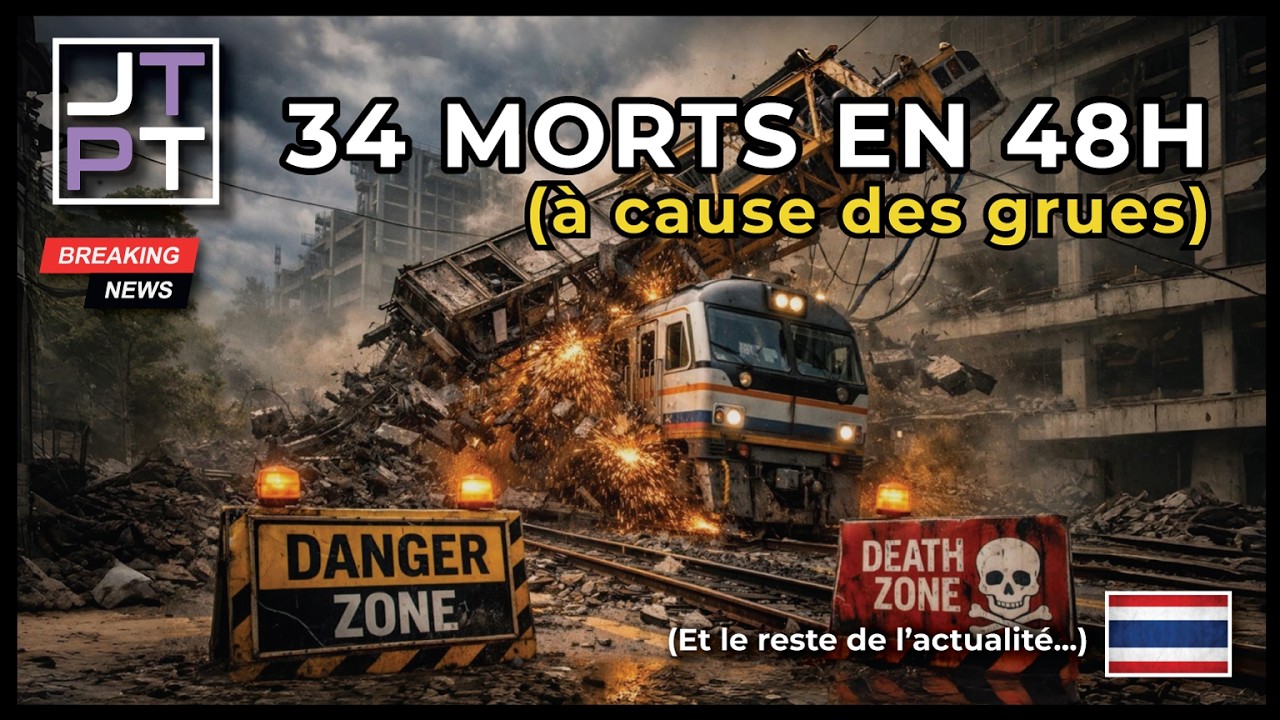
The first shock struck without warning. A construction crane collapses on a train in circulation in the Bangkok region, causing a derailment and a terrifying human toll: more than 32 dead and 66 injured according to figures advanced in the weekly edition of JTPT. The images filmed on site – dazed travelers, rescuers searching the overturned cars – revive dark memories. Thailand had not experienced a railway disaster of such magnitude since the 1979 collision, which killed 51 and injured 130. Unlike then, the investigation today targets an exogenous factor to the rail: the fall of construction equipment.
Among the stories that tighten the throat: a young woman who was going to her father's funeral, cut down en route by the inconceivable; a Thai-Korean couple, just married, victim at D+1. The tragedy spares no one and recalls that the sustained urbanization of Bangkok requires irreproachable safety standards.
Rama 2, this road that collects dramas
Two days later, a second crane accident occurs on the Rama 2 road, sadly famous for its perilous construction sites and its series of pile-ups. Outcome: two additional deaths. The causes? The first elements mentioned by local media and the JTPT channel point to multiple failures: insufficient checks, supervision gaps, poorly applied safety standards. The road itself has experienced other incidents in the aftermath, such as the explosion of a 1,000 mm pipe which engulfed a car and paralyzed traffic. A few hours later, a crane truck overturns, two injured. When bad luck strikes, systemic flaws always end up being seen.
Who is Italian‑Thai Development, the company at the heart of the storm?
The two construction sites involved are the responsibility of Italian‑Thai Development (ITD), a construction giant founded in 1954 by Thai and Italian associates, and listed on the stock exchange in 1994 (initial capital announced: 2.5 billion baht). Its CV has long pleaded for it: participation in the construction of Suvarnabhumi, sections of the BTS Skytrain and the MRT, motorway extensions around Bangkok. So many references that explain why the State has often retained ITD for its major works.
But the addition of recent dramas would now reshuffle the cards. According to JTPT, the authorities have decided to blacklist ITD and suspend current contracts. The company would still retain 15 active contracts at this stage, but the situation could evolve. Cruel dilemma: delay strategic infrastructure projects or continue as if nothing had happened? The executive branch has decided, not without measuring the consequences for land use planning.
Compensations and responsibility: « too much is too much »
For the victims and their families, it is a time of waiting and anger. The amounts of compensation advanced vary greatly, from tens to hundreds of thousands of baht, while the Royal House would pay an additional 20,000 baht per victim, according to information relayed by JTPT. Prime Minister Anutin would support, for his part, compensations up to millions of baht, considering the amounts envisaged too low in view of the broken lives. The material damage of the first disaster would exceed 100 million baht.
Beyond the checks, trust must be rebuilt. The repetition of accidents – particularly on Rama 2 – requires a redesign of the safety chain on construction sites: independent control of cranes, maintenance audits, traceability of critical parts, exclusion devices around railway tracks, monetary accountability of project owners and insurers in the event of proven failures. The image of the sector depends on it, as does the lives of users.
Washington tightens the screw: freeze on immigrant visas for 75 countries, including Thailand
Another burning issue: the US State Department has ordered the suspension of immigrant visas from January 21, 2026 for a list of 75 countries, including Thailand, according to information relayed by JTPT. The neighbors Laos, Cambodia and Myanmar would also be concerned. This measure would be part of a tightening of migration policy under the administration of President Donald Trump.
The Thai Ministry of Foreign Affairs is requesting clarifications and highlights the contribution of Thai nationals to the American economy: entrepreneurs, health professionals, qualified employees. Behind the scenes, Bangkok is seeking adjustments, or even a partial revision of the measure. The immediate question remains: what happens to pending cases? Without detailed official clarification, uncertainty prevails. Candidates for immigration to the United States are invited to frequently consult official channels (embassy, consulate) and to document their steps.
What this changes concretely
- Who is affected? Immigrant visas (family, employment, diversity categories, etc.). Tourism and other non-immigrant categories are not explicitly mentioned in the relayed announcement, so caution is advised until the detailed official communication is published.
- From when? January 21, 2026, unless modified. Applications already submitted could be frozen.
- How long? Undetermined at this stage. The measure could evolve depending on the political situation and bilateral negotiations.
Beyond individual destinies, the symbolic scope is strong: the migratory climate is tense, and Thailand finds itself, like many countries in Africa and Latin America, on a list that reshuffles the cards of international mobility.
2026 Tax in Thailand: CRS changes the game, not the rates
The acronym may make you smile, it is not trivial. The CRS (Common Reporting Standard) is not a new tax but a standard for automatic exchange of financial information between tax administrations. In plain language: more transparency on your accounts, including those held abroad via "offshore" banks and participating institutions.
According to JTPT, Thailand is equipping itself and intensifying its checks. The principle remains the classic one of tax residence: beyond 180 days spent in the country in a year, you are deemed resident and your relevant income falls within the scope of Thai tax. The CRS does not add a...